Walter Nathan Hirsch
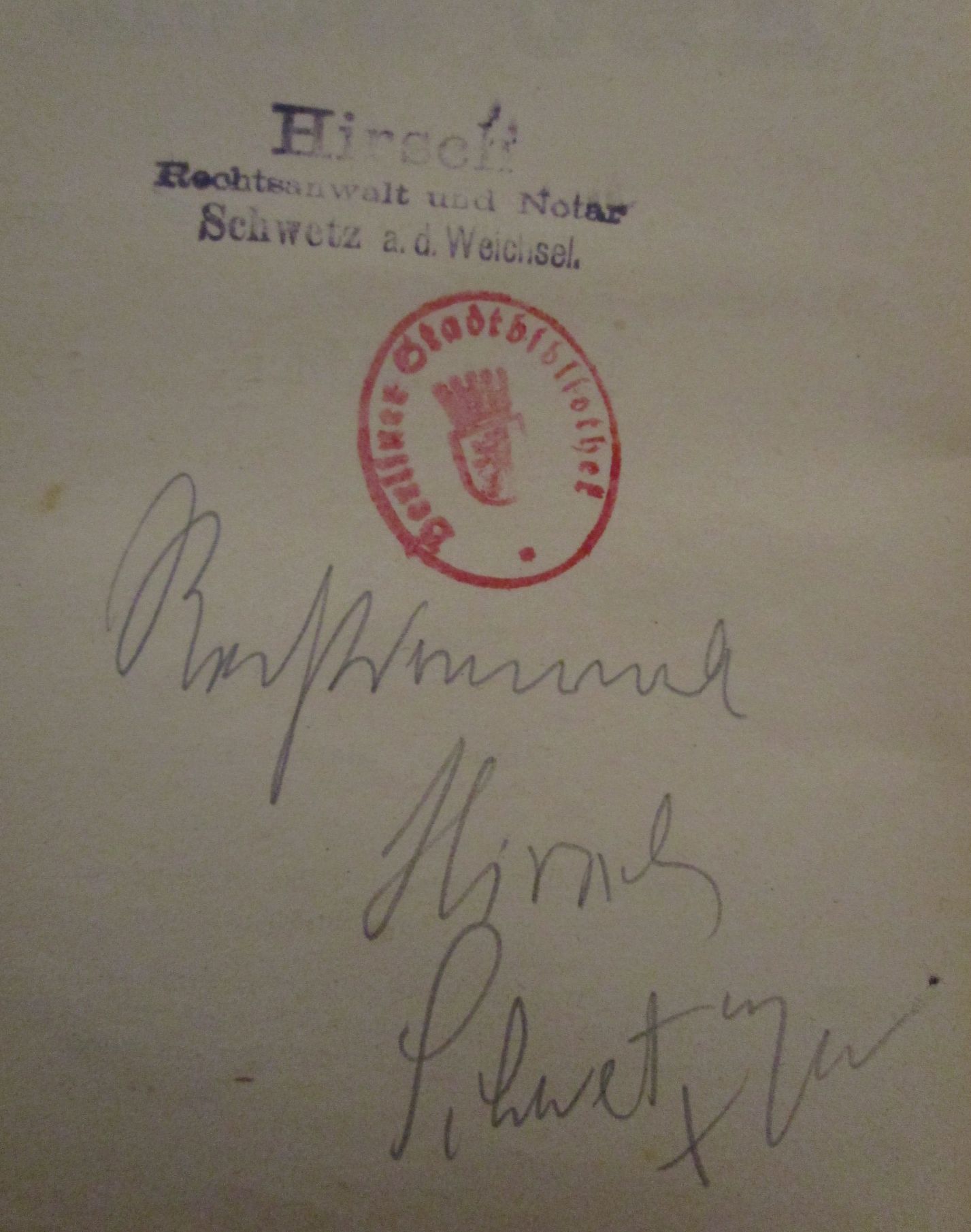
Stamp and signature of Walter Hirsch, as well as a stamp of the Berlin City Library
Since 2020, four books from Walter Nathan Hirsch's library could be returned.
The location, occupation and date (7 April) indicated in the provenance marks of the examined books clearly identify lawyer Dr Walter Nathan Hirsch as the previous owner.
Walter Hirsch was born on 7 April 1896 in Schwetz an der Weichsel (Prussia, now Świecie in Poland) as the youngest child of Alexander Hirsch (1862-1919) and Marie Zadik (1872-1931). He studied law in Breslau and soon after graduating moved to Berlin. There, in 1925, he married Käthe Johanna Seelig (born on 3 February 1902 in Berlin). They lived at Tauentzienstr. 7, which is where Walter Hirsch also moved his law office in 1928.
The couple had six children: Manfred Alexander (born 14 June 1926), Marianne (born 4 June 1927), Ulrich Steffen (born 3 June 1929), Dieter Wolfgang (born 27 October 1931), Dorothea Maria (born 29 April 1935) and Alice (born 14 August 1937).
Due to the Law for the Restoration of the Professional Civil Service of 7 April 1933, Walter Hirsch's licence to practise law was revoked. As a World War I veteran, he was temporarily reinstated, however, in 1935 he was first stripped of his notary's licence, and from 1938 onwards, like all Jewish lawyers in Germany, he was subject to a general professional ban. In the same year, he was also temporarily taken into ‘protective custody’ at Sachsenhausen concentration camp.
Attempts to escape from Germany – first to the United States, later to Cuba – failed. On 24 October 1941, the Hirsch family was deported to the Litzmannstadt ghetto. There, Walter Hirsch was forced to work in the ‘Ordnungsdienst’, a kind of ghetto police.
Marianne Hirsch died there on 22 December 1942 at the age of 15, followed by her eldest brother Manfred on 27 September 1943 at the age of 17, both of them ultimately died of tuberculosis.
Käthe Hirsch also died in Litzmannstadt in April 1944. Walter Hirsch and his four remaining children, Ulrich, Dieter, Dorothea and Alice, aged 7-15, were deported to the Auschwitz extermination camp in the autumn of 1944 and murdered there.
The route by which the volumes entered the holdings of the Central and Regional Library is unclear and could not be traced with certainty. The items were located in unprocessed storage holdings of the Berlin City Library (Berliner Stadtbibliothek, BStB) or were incorporated as ‘gifts’ shortly after the end of the war in 1945/46. It is presumed that the BStB acquired them in 1943 as part of the purchase of approximately 40,000 books stolen from Berlin Jews.
Additional information
- Essay on the Hirsch family by Malte Holler in: Berliner Juden im Getto Litzmannstadt 1941_1944. (2009), p. 119 ff.
- Entries by Dr. Judith Hahn for the Hirsch family on the website of the Stolpersteine Berlin Coordination Office
The restituted objects at lootedculturalassets.de
- Eheberg, Karl Theodor von: Finanzwissenschaft. Leipzig [u.a.]: Deichert [u.a.], 1920.
- Richter, Eugen: Politisches ABC-Buch : Ein Lexikon parlamentarischer Zeit- und Streitfragen. Berlin: Verl.: „Fortschritt, Aktienges.“, 1896.
- Schlaf, Johannes: Religion und Kosmos. Berlin: Hofmann, 1911.
- Speckmann, Diederich: Heidjers Heimkehr : eine Erzählung aus der Lüneburger Heide. Berlin: Warneck, 1916.