Manfred George
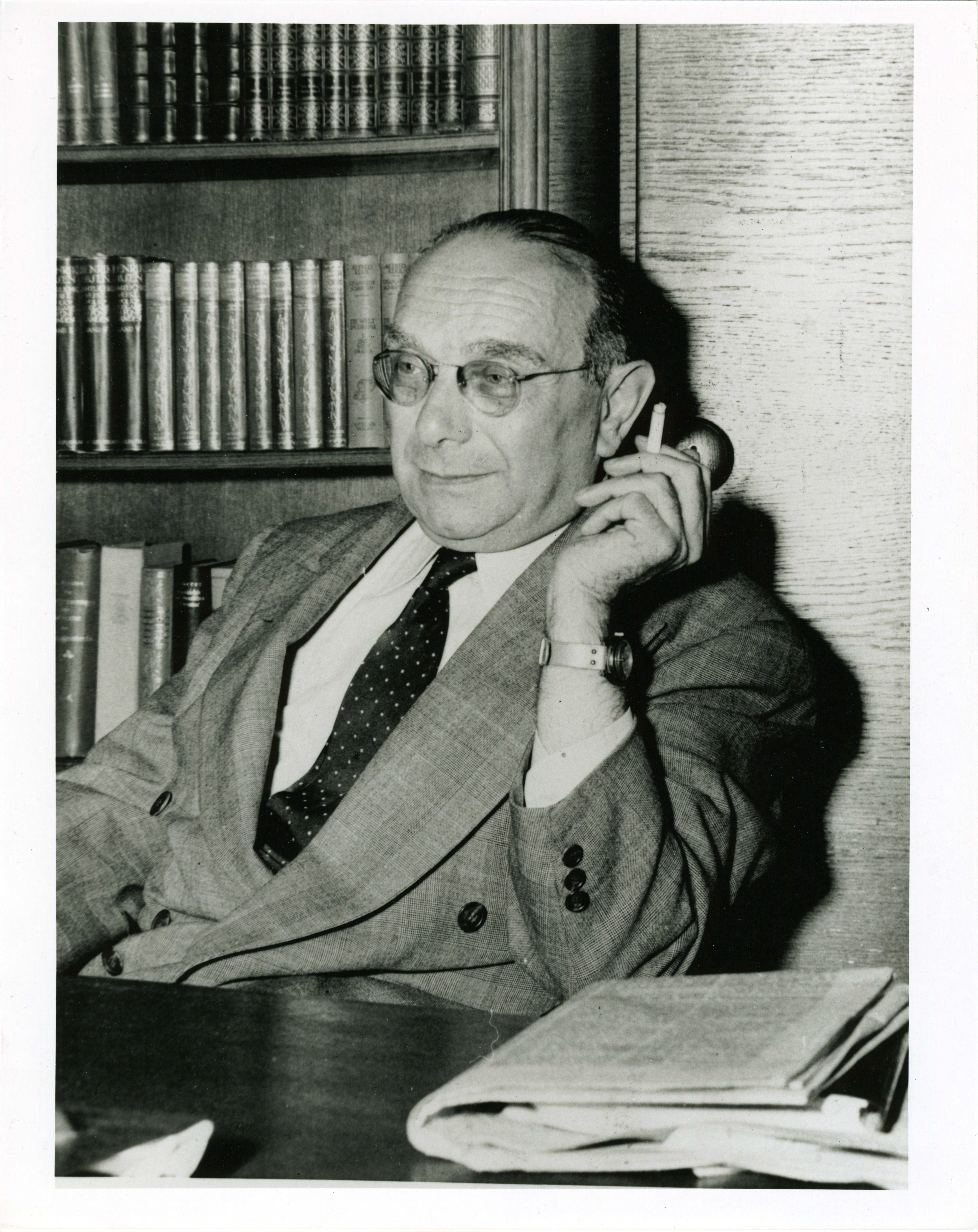
Manfred George in his office, probably in the 1950s (Photo: Manfred George, Leo Baeck Institute, F 13614.)
In 2026, eight books from Manfred George’s library could be returned. The restitution was carried out in cooperation with the University Library of the Freie Universität (FU) Berlin, which in turn was able to return one more book.
On the basis of the autographs “Manfred Georg” and, in one case, “Manfred Georg Cohn” found in the books, a comparison of signatures clearly identified the journalist Manfred George as the previous owner.
Two of the books can be traced back to a purchase made in 1943, when the Berlin City Library (Berliner Stadtbibliothek, BStB) acquired around 40,000 books from the last homes of deported Berlin Jews from the Berlin Municipal Pawnshop (Städtische Pfandleihanstalt Berlin). The BStB sold around 20,000 of these books directly to various Berlin institutions, individuals from the municipal administration and to bookshops. By 20 April 1945, the library had catalogued just under 2,000 of the remaining books, keeping a separate register for this purpose, known as “Zugangsbuch J” (Access Book J). At least part or all of the remaining 18,000 books were incorporated into the collection after the end of the war as “gifts”, often with the supplier details listed as “Kulturamt” (Cultural Office) or “Bücherlager” (Book Storage) The remaining books restituted by the Central and Regional Library of Berlin (Zentral- und Landesbibliothek Berlin, ZLB) therefore most likely also originate from the purchase from the Berlin Municipal Pawnshop. There is as yet no information regarding the access route of the volume identified in the University Library of the FU Berlin.
Manfred George (formerly Manfred Georg, born Manfred Georg Cohn) was born on 22 October 1893 in Berlin. His parents were Carl Cohn (1854–1936), a merchant from Prenzlau in the Uckermark, and Felicia Eleonore Sachs (1861–1907), who hailed from Breslau. Their first son, Fritz Eugen Cohn, had died in January 1891 at the age of just two months.
Manfred George attended the Friedrichs-Gymnasium in Berlin, from which he graduated in 1912. He then studied law in Berlin, Greifswald and Geneva. During World War I, he volunteered as a medical orderly, was seriously wounded in 1915 and discharged from military service. In 1916, he completed his studies in Greifswald with doctoral degree. Whilst still a student, he had already worked for the newspaper Deutsche Montagszeitung and begun a traineeship at the B. Z. am Mittag. From 1917 onwards, he worked as an editor for various newspapers, including the Berliner Morgenpost, the Berliner Allgemeine Zeitung, the Berliner Abendpost and the Vossische Zeitung in Breslau.
On 8 April 1920, Manfred George married Johanna (‘Hanna’) Dorothea Simon in Berlin. She had been born on 9 November 1897 in Charlottenburg, the daughter of the banker Ludwig R. Simon (born on 2 February 1863 in Berlin) and Bianca Simon, née Grünfeld (born on 3 October 1873 in Landeshut, Silesia). Manfred and Hanna George had two children: Franz, born on 27 March 1921 in Berlin, and Renate Judith, born on 18 February 1927, also in Berlin.
Manfred George was a pacifist and a member of the German League for Human Rights (Deutsche Liga für Menschenrechte); he was actively involved in the Never Again War movement and the German Peace Society (Deutsche Friedensgesellschaft). He was also associated with the Zionist movement in Germany and published a biography of Theodor Herzl in 1932. George was active in a wide range of journalistic and publishing fields. He worked alternately for the Ullstein and Mosse publishing houses, was a theatre critic, wrote radio plays and contributed to Die Weltbühne. In 1924, he had co-founded the Republican Party of Germany (Republikanische Partei Deutschlands, RDP) with Carl von Ossietzky, amongst others; however, the party disbanded within the same year.
In Nazi Germany, Manfred George’s family was persecuted as Jewish. After the Nazis came to power in 1933, the family fled to Prague. George continued his journalistic work there, writing for the émigré newspaper Prager Montagsblatt and the Prager Tagblatt, amongst others, and serving as a correspondent for the Pariser Tageblatt and the Basler Nationalzeitung. From mid-1936, he was editor-in-chief of the Jüdische Revue.
In 1938, George was stripped of his German citizenship. He escaped through Hungary, Yugoslavia, Italy, Switzerland and France, eventually reaching the United States, where he arrived in New York with Hanna on 24 September 1938. Frank and Renate were in Kent, England, at the time. They were able to join their parents by 1940 at the latest. Hanna’s parents, however, were both victims of the Shoah. Bianca Simon (née Grünfeld) was deported to the Riga Ghetto on 13 January 1942 and murdered at an unknown date. Ludwig R. Simon was deported to the Theresienstadt concentration camp on 8 September 1942 and murdered there on 23 December 1942.
In the United States, Manfred changed his surname to George, Hanna changed her first name to Jeanette, Franz changed his to Frank, and Renate changed hers to Renée. From March 1939, Manfred George was editor-in-chief of the Aufbau in New York; he managed to increase its circulation tenfold and develop it into the most important German-language exile newspaper. He remained editor-in-chief of the Aufbau until his death on 30 December 1965 in New York. Jeanette Hanna George followed him on 30 April 1987.
Additional information
- Borrmann, Jennifer / Vordermayer, Thomas, „George, Manfred“ in: NDB-online, published on 1 July 2025, (online: https://www.deutsche-biographie.de/gnd121978281.html, last accessed on 2 June 2026)
- Röder, Werner und Strauss, Herbert A. (ed.): Biographisches Handbuch der deutschsprachigen Emigration nach 1933. Band 1: Politik, Wirtschaft, Öffentliches Leben. München: Saur, 1980, p. 217f.
- Reichshandbuch der Deutschen Gesellschaft : Das Handbuch der Persönlichkeiten in Wort und Bild. (Erster Band : A–K), Berlin, 1930. p. 534
- Stolpersteine in Berlin: Ludwig R. Simon
The restituted objects at lootedculturalassets.de
- Aufhäuser, Siegfried: Weltkrieg und Angestelltenbewegung. (Sozialwissenschaftliche Bibliothek : 6). Berlin: Verl. für Sozialwissenschaft, 1918.
- Corrinth, Curt: Das grosse Gebet : Neue Gedichte. Berlin: Oesterheld, 1919.
- Géraldy, Paul: Toi et moi. Paris: Stock, [1923].
- Latzko, Andreas: Friedensgericht. (Europäische Bücher). Zürich: Rascher, 1918.
- Mehring, Walter: Neubestelltes abenteuerliches Tierhaus : eine Zoologie des Aberglaubens, der Mystik und Mythologie vom Mittelalter bis auf unsere Zeit. Potsdam: Kiepenheuer, 1925.
- Miller, Alfred: Die Jesuiten : Ordensleben und Schicksale. (Voigtländers Quellenbücher : 77). Leipzig: Voigtländer, um 1914.
- Schickele, René: Aïssé : Novelle. (Der jüngste Tag : 24). Leipzig: Wolff, 1916.
- Schickele, René: Benkal der Frauentröster : Ein Roman. Berlin: Cassirer, 1913.