Kurt Fürstenheim
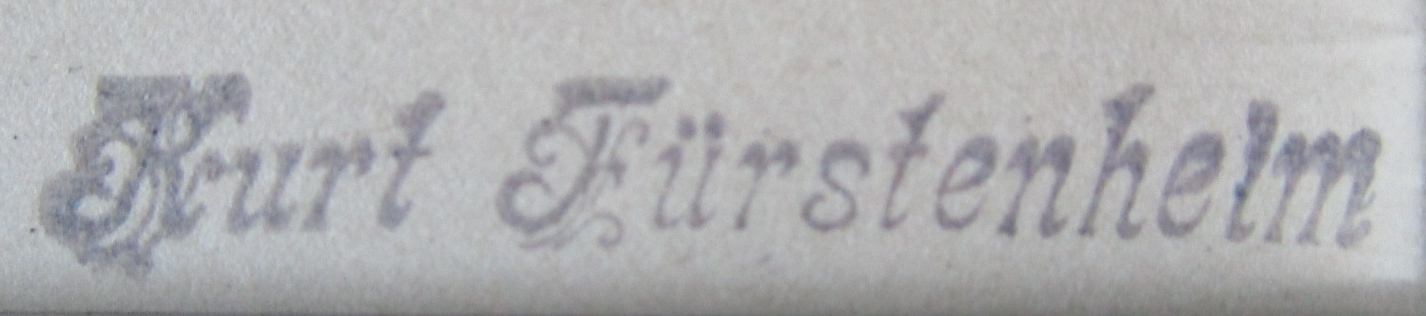
Stamp: "Kurt Fürstenheim"
In 2026, a book from the library of Kurt Fürstenheim could be returned.
The stamp ‘Kurt Fürstenheim’ found in the book, cross-references with address books and the fact that the item is a medical book made it possible to identify the physician Kurt Fürstenheim as the book’s previous owner.
Kurt Fürstenheim was born on 31 May 1886 in Berlin. His parents were the medical doctor Ernst Fürstenheim (1836–1904) and Anna Dorothee Christiane Fürstenheim, née Pressler (1852–1936).
Kurt Fürstenheim set up his medical practice in Biesenthal (Brandenburg) in 1913. In 1922, he moved his practice to Berlin, initially to Schöneberg, and then, in 1928, to Lichterfelde-Ost. Kurt Fürstenheim was a member of the Reichsbanner Schwarz-Rot-Gold and, from 1919, a member of the German Democratic Party (Deutsche Demokratische Partei, DDP), for which he served as a district representative in Biesenthal and a member of the Oberbarnim regional council until 1933. On 16 September 1913, Kurt Fürstenheim married the piano teacher Marie ‘Mieze’ Kaufmann (1890–1941) in Berlin. The marriage remained childless and ended in divorce in 1928. Marie Fürstenheim (née Kaufmann) was persecuted as Jewish in Nazi Germany. She was deported to the Minsk ghetto in December 1941 and murdered there.
In Nazi Germany, Kurt Fürstenheim was classified as a Mischling of the first degree. He was an active anti-fascist, and his licence to practise as a medical doctor was revoked because of his opposition to fascism. In November 1935, he was denounced, arrested and his flat was searched. In early 1936, he was sentenced to two years and three months’ imprisonment and a three-year ban on practising his profession for performing two abortions. At the end of 1937, Kurt Fürstenheim received an early release from prison on grounds of good behaviour. Subsequently, his medical licence and his doctorate were also revoked. After this, Kurt Fürstenheim initially lived with his brother Hans Fürstenheim in Berlin-Halensee and subsequently with a woman named Marie Louise Krause at Pariser Straße 2 in Berlin.
Kurt Fürstenheim lived in Berlin until the end of World War II. Towards the end of 1941, he worked as a merchant at the Carl Elling wholesale firm, and from around the end of 1943 until March 1945, he was a research assistant in the pharmaceutical department of the Diwag chemical works in Berlin-Waidmannslust. At the same time, he was active in the resistance against the Nazis as a member of the Saefkow-Jacob-Bästlein Organization.
After the end of the war, Kurt Fürstenheim was reinstated as a medical doctor and moved to Alt Ruppin (Brandenburg), where he practiced medicine for the Red Army. In late 1945, he married Else Wiesinger, who had been born on 13 February 1897 in Rathenow. However, she passed away just over a year later, on 24 January 1947. This marriage also remained childless.
After 1945, Kurt Fürstenheim was a member of the Liberal Democratic Party of Germany (Liberal-Demokratische Partei Deutschlands, LDP), for which he also served as a district representative, as well as of the Free German Trade Union Federation (Freier Deutscher Gewerkschaftsbund, FDGB), the Society for German-Soviet Friendship (Gesellschaft für Deutsch-Sowjetische Freundschaft, DSF) and the Association of Victims of Nazi Persecution (Vereinigung der Verfolgten des Naziregimes, VVN). Following legal proceedings against Kurt Fürstenheim concerning his involvement in providing abortions, his status as a victim of Nazi persecution was reviewed and revoked in 1953. It was argued that Fürstenheim had not been a political prisoner and, as a Mischling of the first degree, had not been arrested or interned in forced labour camps. It was also claimed that he exhibited ‘strong capitalist tendencies’.
Nothing is known about the remainder of his life. Kurt Fürstenheim died in 1975.
Kurt Fürstenheim had two siblings. His brother Hans Claus Fürstenheim (born on 5 February 1884 in Berlin) escaped to the United States in 1939 with his wife Charlotte Fürstenheim, née Fischer (1887–1981). He died in New York in 1962. As far as is known, the couple had only one son, Ernst Werner Fürstenheim, born on 4 January 1910 in Berlin, who died in Berlin on 29 February 1936 at the age of 26 and had no descendants. Kurt’s sister Charlotte (born 27 May 1887 in Berlin) had already escaped to the United States in 1936 with her husband Wilhelm Heimann (1887–1980) and her son Peter Klaus Heimann (1918–2003). She died in Hamburg in 1968.
Kurt Fürstenheim also had four half-siblings from his father’s first marriage to Luise Fürstenheim (née Steinthal) (1842–1880): Erna, Frieda, Walter and Louise Else. Erna Fürstenheim was born on 1 April 1877 in Berlin. She was murdered on 15 June 1942 at the Sobibor extermination camp. Frieda Fürstenheim was born on 5 May 1878 in Berlin and was also murdered on 15 June 1942 in Sobibor. Walter Fürstenheim (born on 25 July 1879 in Berlin) survived the Shoah with his wife Elisabeth Fürstenheim, née Sauter (1879–1965), after emigrating to England. He died on 2 August 1967 in Frankfurt am Main. Louise Else Fürstenheim, born on 12 November 1880, died in England in 1900.
Kurt Fürstenheim’s biography raises a number of questions regarding how the looted book became part of the Berlin City Library’s collection, questions which have yet to be conclusively answered. The classification of the book as Nazi-looted property is unequivocal, given that it entered the collection via the Pfandleihanstalt in 1943. The attribution of the stamp found in the book to Kurt Fürstenheim was based on prima facie evidence. However, as yet we can only speculate as to how the book came to be in the collection of the Pfandleihanstalt. It is possible that the book had already been confiscated by the end of 1935, or that Fürstenheim was forced to sell it in 1937 following his release from prison. It is also possible, however, that at the time of its confiscation, the book was in the possession of one of his siblings or half-siblings.
Additional information
- Berlin.de: Memorial to Frieda Fürstenheim.
- Brandenburgisches Landeshauptarchiv. Oberfinanzpräsident Berlin-Brandenburg (II) Vermögensverwertungsstelle. Rep. 36A (II) 10762. Hans Claus Fürstenheim
- Brandenburgisches Landeshauptarchiv. Bezirkstag und Rat des Bezirkes Potsdam - Bezirksverwaltungsbehörde Potsdam. Rep. 401 RdB Pdm 37657. Fürstenheim, Dr. Kurt
- Brandenburgisches Landeshauptarchiv. Bezirkstag und Rat des Bezirkes Frankfurt (Oder) - Bezirksverwaltungsbehörde Frankfurt (Oder). Rep. 601 RdB FfO VdN-247. Fürstenheim, Dr. Kurt
- Keim, Klaus: Widerstand in Berlin gegen das NS-Regime 1933 bis 1945 : Ein biographisches Lexikon. Band 2 [Buchstabe C bis G] Caden-Gzeck. Berlin: trafo-Verl., 2003. S. 215.
- Mapping the Lives: Kurt Fürstenheim