Auerbach Family
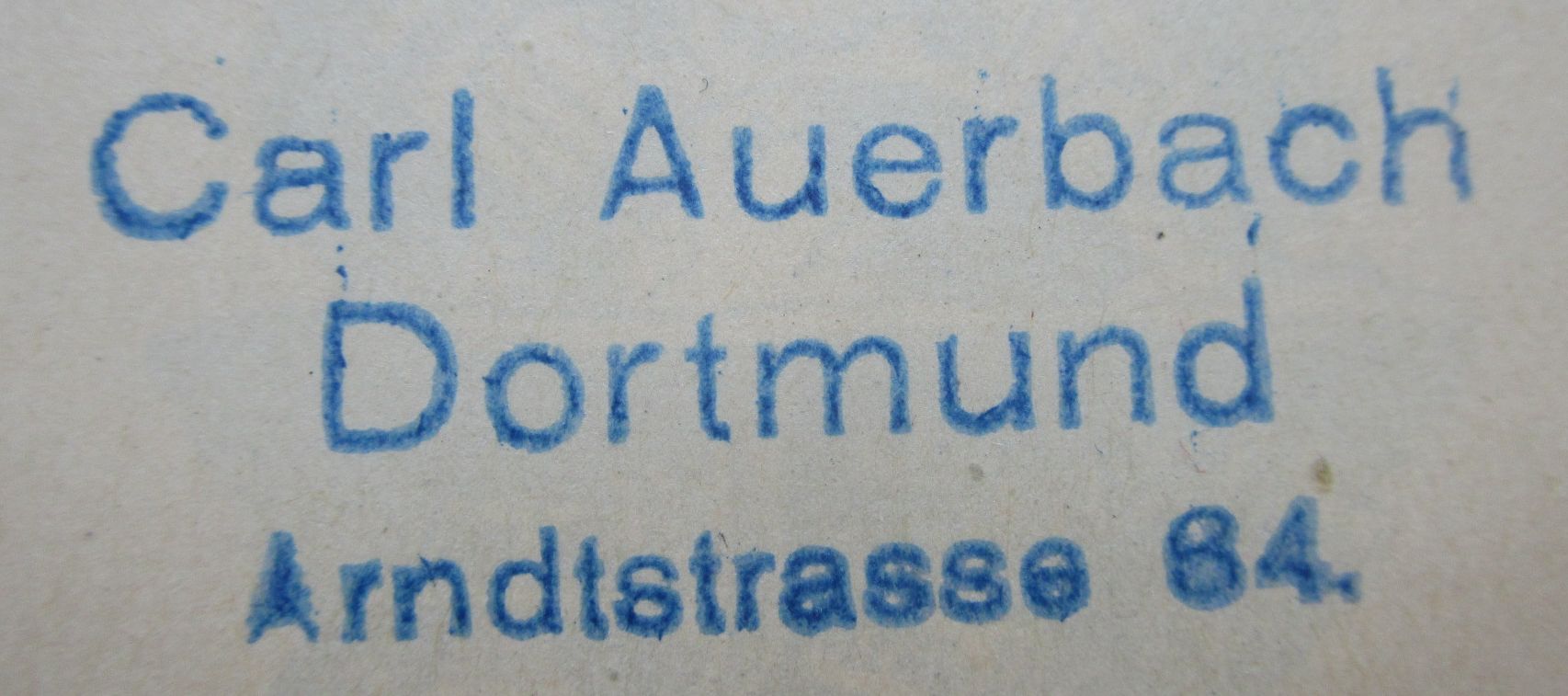
Stamp: "Carl Auerbach Dortmund Arndtstrasse 64."
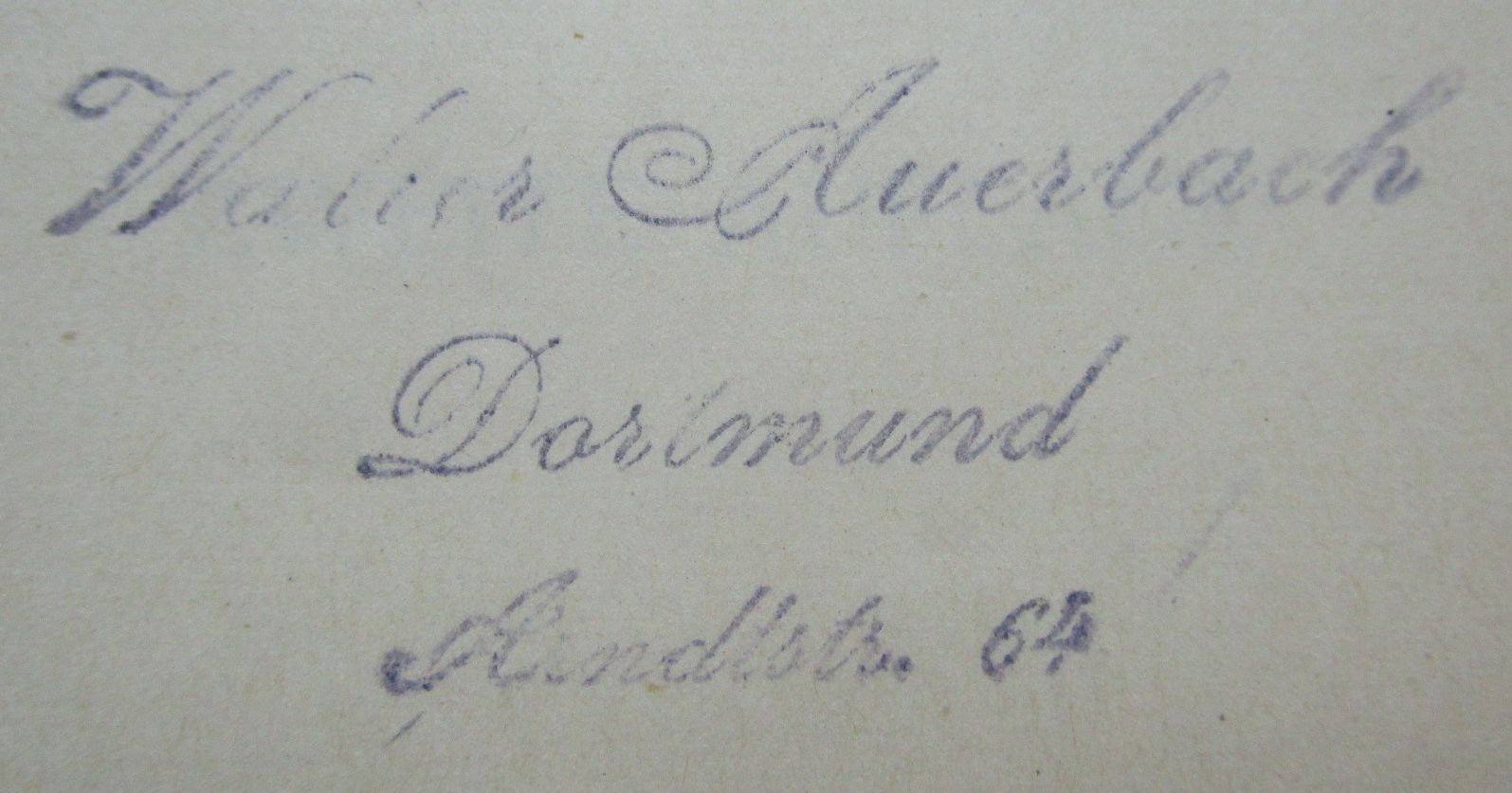
Stamp: "Walter Auerbach Dortmund Arndtstr. 64."
In December 2025, a looted book that belonged to the Auerbach family could be returned.
The Latin-German school dictionary from 1911 was purchased in 1942 by the Berlin City Library (Berliner Stadtbibliothek, BStB) from the Berlin Municipal Pawnshop (Städtische Pfandleihanstalt Berlin). The BStB acquired it together with ~130 other books, about half of which were dictionaries and the other half foreign-language literature. Shortly afterwards, the BStB procured ~40,000 looted books from the Berlin Municipal Pawnshop, which were proven to have come from the last homes of deported Jewish Berliners. Based on the current state of research, it can be assumed that these books, purchased in 1942, are all to be regarded as Nazi-looted assets.
The address Arndtstr. 64 established an unambiguous connection to the Auerbach family in Dortmund. This address was the home of entrepreneur Paul Auerbach (1868-1930), his wife Stephanie Auerbach, née Lehmann (1880-1936), and their three sons Karl/Carl (born on 29 September 1902 in Dortmund), Walter (born on 2 April 1908 in Dortmund) and Arthur (born on 26 June 1910 in Dortmund).
After completing his schooling in Dortmund, Carl Auerbach initially studied law in Bonn and Munich, but dropped out after three semesters to help out in the family business, Gebr. Auerbach, following the death of an uncle. Around 1930, the company was dissolved as a result of the Great Depression, and after his father's death, Carl Auerbach moved to Berlin, where he initially worked as a sales representative. In 1931, he married Hildegard (Hilda) Czibulski (1903-1987), a musician from Barmen (Wuppertal).
After the Nazis came to power, Carl and Hilda Auerbach were targeted by the Nazis, and the windows of their apartment were smashed one night in 1933. From that same year, Carl Auerbach was the general representative for Berlin and Brandenburg for the Rapido weighing machine factory in Dresden-Radebeul. In 1938, Carl Auerbach was forced out of his job because of his Jewish heritage. Unable to find employment, Carl Auerbach was forced to sell his Ford automobile, among other things. In 1939, he managed to escape to Great Britain, where he initially found work as a domestic servant – he had attended a servant training school in Berlin before emigrating. His wife Hilda worked in the same household as a cook. The furnishings of Carl and Hilda Auerbach's apartment at Motzstraße 78 had to remain in Berlin, including a Steinway grand piano and a library of approximately 2,000 volumes. After being interned as an Enemy Alien in England for a short time, Carl Auerbach worked as a driver in the air raid protection service and as a paramedic. Hilda Auerbach suffered from severe depression and permanent anxiety as a result of Nazi persecution.
After the war, Carl Auerbach gradually found work again as a sales representative. His marriage to Hilda Auerbach broke down in England after 1945. In 1962, Carl Auerbach married Barbara Theodora Güttel (née Wohlwill, born on 12 October 1908 in Hamburg), who had also fled to England and with whom he had been living in Croydon, Surrey, since around 1950. Carl Auerbach died in England in 1975, and Barbara Auerbach followed him in 1991.
Walter Auerbach was a stage designer and photographer. After graduating from high school in Dortmund, he studied art history in Marburg and worked as an assistant and later as a stand-alone stage designer in Münster, Darmstadt and finally in Berlin, including at the Theater am Schiffbauerdamm. From around 1930, he lived there with photographers Grete Stern (1904–1999) and Ellen Rosenberg (born on 20 May 1906 in Karlsruhe), who together ran the ringl + pit photo studio. Walter Auerbach continued to work as a stage designer, from 1933 onwards for the Jüdischer Kulturbund, among others. He was a close friend of the Marxist philosopher Karl Korsch and a member of the Communist Workers' Party of Germany (KAPD).
Walter Auerbach, Ellen Rosenberg and Grete Stern were persecuted as Jewish in Nazi Germany. All three of them escaped in 1933, Walter Auerbach and Ellen Rosenberg initially to the British Mandate of Palestine, where they opened Ishon, a studio for children's photography, and shot the film ‘Tel Aviv’ for the Jewish National Fund (KKL), among other things. Walter Auerbach returned to Berlin temporarily until he finally left for good in January 1935. He left his flat at Kurfürstenstr. 20 to his brother Arthur, along with the furniture and a library of about 1,200 books.
After the Arab Revolt began in 1936, they decided to close their photo studio and leave the British Mandate of Palestine. They first moved to London to join Grete Stern, who had fled there, and through her contacts made friends with artists in exile, including Bertolt Brecht and Hanns Eisler. However, Walter Auerbach and Ellen Rosenberg were unable to obtain residence and work permits in England, so they both emigrated to the United States. Walter Auerbach and Ellen Rosenberg married in England in 1937, partly because this meant they only had to obtain one joint visa for the United States.
There, Walter and Ellen Auerbach initially lived in Elkins Park, Pennsylvania, a suburb of Philadelphia, and earned a living taking photographs of children. Walter Auerbach was unable to find work as a stage designer and took on jobs as a domestic servant, construction worker, sailor and peddler, among other things. Ellen Auerbach made it onto the cover of Life magazine in 1938 with a photograph of a child and established herself as a photographer. The couple made contacts with artists such as Willem de Kooning and Fairfield Porter, and Walter renewed his contact with Karl Korsch and the communist Paul Mattick, with whom he had already corresponded from Berlin. After the Japanese attack on Pearl Harbour, Walter Auerbach was drafted into military service in 1943. Since he was declared unfit for military service, he served as a photographer at the Army Medical Museum in Washington. In 1943, Walter and Ellen Auerbach received US citizenship. In 1944, Walter Auerbach was honorably discharged from the military for medical reasons.
From 1943/44 onwards, Walter and Ellen Auerbach's relationship began to fall apart. Both moved separately from Elkins Park to New York City. Walter Auerbach eventually settled in Deià on Mallorca. In the post-war years, he continued to correspond extensively with Ellen Auerbach and his brother Carl, travelled and took photographs. Walter Auerbach's health deteriorated progressively; he had been suffering from multiple sclerosis since around 1944. Around 1960, he began a relationship with his future second wife, Doreen Holles (née Elderton, 1921–2006), an acquaintance of Barbara and Carl Auerbach. Walter Auerbach died on 5 July 1966 in Mallorca.
Little is known about Arthur Auerbach. In 1939, he lived with his brother Carl in Berlin at Kurfürstenstr. 20. In 1941, Arthur Auerbach was deported from Berlin to Minsk and murdered there. Based on the access route via the Berlin Municipal Pawnshop, which, among other things, ‘utilised’ books from the last apartments of deported Berlin Jews, it can be assumed that Arthur Auerbach was the last owner of the book before it was confiscated.
The ZLB would like to express its sincere thanks to Anne Webber (Commission for Looted Art in Europe) and Klaus Winter (Jüdische Heimat Dortmund) for their support in bringing about this restitution.
Additional information
- Arolsen Archives: DocID 11221091 (Arthur Auerbach).
- bauhaus kooperation berlin dessau weimar: Ellen Auerbach.
- BLHA Rep. 36A (II) 1346. Auerbach, Arthur.
- BLHA Rep. 36A (II) 1348. Auerbach, Carl.
- Graeve Ingelmann, Inka: Ellen Auerbach. Das dritte Auge. Leben und Werk. München: Schirmer/Mosel, 2006.
- Koch, Manfred: Ellen Auerbach geb. Rosenberg.
- Mapping the Lives: Arthur Auerbach.
- Messner, Anna Sophia: Palästina/Israel im Blick : Bildgeographien deutsch-jüdischer Fotografinnen nach 1933. Göttingen: Walstein, 2023. p. 185 ff.
- Winter, Klaus: Paul Auerbach.